
Nuclear reactor accidents are of two types:
- Design basis accidents(DBA): These are the events which are considered while designing nuclear plants and it's made sure no major damage occurs during such events. Loss of coolant accident or LOCA is one such example.
- Beyond design basis accidents: These are caused by unforeseen extreme conditions and probability of core damage and leakage of radioactivity are high.[1]
Japan was hit by a major earthquake following which a 15-meter high Tsunami flooded a nuclear plant with water causing power outage leading to one of the major nuclear reactor accidents in history which began on March 11, 2011 and lasted for two weeks before a cold shutdown of the plant was announced.

It was level 7 accident according to the International Nuclear and Radiological scale.
Reactors 1, 2, 3 of total 6 reactors of Fukushima Daiichi were active at the time. Reactors 1, 2, 3 were automatically shutdown when the earthquakes hit. The reactors were resistant to the earthquake but couldn't stand the tsunami. The cooling systems for residual heat removal from the cores were running on backup generators. Within a few hours, 12 out of 13 backup generators keeping the RHR systems were disabled due to the flooding by the 15 meter high tsunami resulting in disabling of the heat exchangers which dumped waste heat and decay heat into sea. As a result, the three reactors were unable to maintain a proper cooling and water circulation. Passively cooled core isolation generators were used here but couldn't provide adequate cooling due to the flooding of batteries.[2]
The basis for the design of Fukushima plant was based on 1960 Chile tsunami which was 3.1 m high and hence the plant was built 10 m above the sea level with sea pumps situated at a height of 4 m. This was a 'beyond design basis accident'. The tsunami came ashore at a height of around 15 meters, and the Daiichi turbine halls were submerged in seawater for roughly 5 meters until the waters receded.
What exactly happened?
The earthquake didn't cause any severe damage to the reactors, and operating units 1-3 were immediately turned down in response to it, as planned. All six external power sources were disabled at the same time due to seismic damage, thus the emergency diesel generators in the turbine buildings' basements kicked in. The main steam circuit, which bypassed the turbine and went via the condensers, would have provided initial cooling.[3]
The seawater pumps for both the main condenser circuits and the auxiliary cooling circuits, especially the residual heat removal (RHR) cooling system, were submerged and damaged due to the flooded seawater. The tsunami also flooded the diesel generators, as well as the electrical switchgear and batteries, which were all located in the turbine buildings' basement, resulting in a station blackout resulting in a station blackout isolating the reactors from their heat sink.[3]
Units 1&2 had their 125-volt DC back-up batteries flooded and failed, leaving them without instruments, control, or lighting. The battery in Unit 3 lasted roughly 30 hours. A nuclear emergency was announced at 7:03 p.m. on Friday, March 11th, and the Fukushima prefecture issued an evacuation order for individuals within 2 kilometers of the facility at 8:50 p.m.
Inside the reactors:
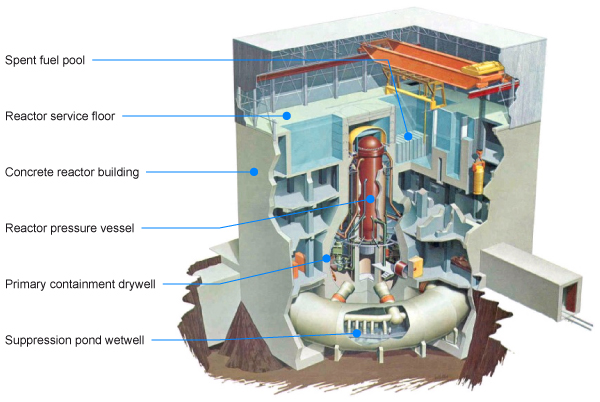
The Fukushima Daiichi reactors were GE boiling water reactors (BWRs) with a Mark I containment. Unit 1 had a capacity of 460 MW, units 2–5 had a capacity of 784 MW, and unit 6 had a capacity of 1100 MW.
The reactor cores would have been producing about 1.5 percent of their nominal thermal output from fission product decay when the power failed at 3:42 pm, nearly an hour after the fission processes were shut down - about 22 MW in unit 1 and 33 MW in units 2&3. This produced a lot of steam in the reactor pressure vessels (RPVs) housing the cores, which was released into the dry primary containment (PCV) through safety valves because there was no heat removal through circulation to an exterior heat exchanger. After the water level dropped, this was followed by hydrogen, which was evolved by the reaction of the fuel's extremely heated zirconium coating with steam.[3]
The steam was diverted into the suppression chamber/wet well under the reactor, within the containment, as pressure began to rise here, but the internal temperature and pressure continued to climb fast. Water injection began, with several systems and, finally, the emergency core cooling system being used (ECCS). These systems failed over three days, thus water injection to the RPV was done with fire pumps starting early Saturday, although the internal pressures had to be eased first by venting into the suppression chamber/wet well. The injection of seawater into unit 1 began at 7:00 p.m. on Saturday, December 12, and continued into unit 3 on Sunday, December 13, and unit 2 on Monday, December 14.
The water level in unit 1 dropped to the top of the fuel three hours after the scram and to the bottom of the fuel 1.5 hours later, according to reports. The exposed fuel's temperature soared to around 2800°C, causing the core part to melt within a few hours, and by 16 hours after the scram, the majority of it had fallen into the water at the RPV's bottom. Following that, the temperature of the RPV gradually reduced.
After hydrogen mixed with air and ignited, a hydrogen explosion occurred on the service floor of the building above unit 1 reactor containment at 3:36 p.m. on Saturday, blowing off the roof and cladding on the top part of the building and blowing off the roof and cladding on the top part of the building. (When zirconium cladding is oxidised at high temperatures in the presence of steam, hydrogen is produced exothermically, worsening the fuel decay heat problem.)[3]
The majority of the core – as corium, comprising of melted fuel and control rods – was thought to be in the bottom of the RPV in unit 1, but it eventually emerged that it had primarily eroded around 65 cm into the drywell concrete below (which is 2.6 m thick). This lowered the heat's intensity and allowed the bulk to solidify. Much of the gasoline in units 2&3 melted to some amount as well, though to a lower extent than in unit 1 and a day or two later. Unit 1 would have been producing 1.8 MW of heat in mid-May 2011, and units 2&3 roughly 3.0 MW apiece.
Much of the fuel in units 2&3 melted to some amount as well, though to a lower extent than in unit 1 and a day or two later. Unit 1 would have been producing 1.8 MW of heat in mid-May 2011, and units 2&3 roughly 3.0 MW apiece.
On Monday 14, the steam-driven backup water injection system in unit 2 failed, and it took nearly six hours for a fire pump to start feeding seawater into the RPV. The RPV pressure had to be alleviated via the wet well before the fire pump could be deployed, which required electricity and nitrogen, resulting in the delay. Meanwhile, after backup cooling was lost, the reactor water level dropped fast, causing core damage around 8 p.m. It is now known that much of the fuel melted and fell into the water at the bottom of the RPV roughly 100 hours after the scram. On Sunday 13 and Tuesday 15, pressure was released, and the blowout panel near the top of the building was opened to prevent a repeat of the hydrogen explosion at unit 1. The pressure suppression chamber beneath the real reactor seemed to breach early on Tuesday 15, probably as a result of a hydrogen explosion there, and the drywell containment pressure within fell. The rupture interpretation was not supported by a second inspection of the suppression chamber. On Tuesday 15, a leak of the primary containment was discovered, according to later investigation. Unit 2 appeared to be the source of the majority of the radioactive leaks from the site.[3]
In unit 3, the main backup water injection system failed around 11:00 a.m. on Saturday, December 12, and water injection using the high-pressure system failed early on Sunday, December 13, causing water levels to plummet. By venting steam into the wet-well, the RPV pressure was decreased, allowing seawater injection using a fire pump to begin shortly before midday. The suppression chamber and containment were successfully vented and contained early on Sunday.
An explosion occurred in defueled unit 4 around 6:00 a.m. on Tuesday, March 15th, destroying the top of the building and further damaging unit 3's superstructure. This was likely due to hydrogen originating in unit 3 and backflowing into unit 4 via shared ducts when unit 3 was evacuated.[3]
The tsunami caused the flooding of reactors resulting in failure in cooling systems and residual heat removal systems. This lead to rise in temperatures resulting in melting of the cores. The pressurized steam in the RPVs was also one of the causes. The hydrogen produced from the water zirconium reaction lead to detonation, which threw out radioactive materials into the atmosphere. A cold shutdown was announced after two weeks.
References:
[1] Sarit K. Das, Department of Mechanical engineering, Indian Institute of Technology, Madras, Heat and mass transfer issues associated with nuclear reactor safety.
[2] Preliminary lessons learned from Fukushima Daiichi accident for advanced nuclear plant development technology, https://www.iaea.org/topics/response/fukushima-daiichi-nuclear-accident
[3] Fukushima Daiichi Accident, https://world-nuclear.org/information-library/safety-and-security/safety-of-plants/fukushima-daiichi-accident.aspx
[4] https://static.javatpoint.com/gk/images/nuclear-power-plants-in-india4.jpg


